
Life Guide
You love cats, but why does your home still make you feel unwell?
For many cat-owning families, the real challenge isn't buying a product—it's finding a sustainable daily routine that balances closeness with your cat and managing allergens, without guilt.
OKCLEAR · 2026.10.16 · About 22 min read

You've done a lot; these actions just haven't been connected yet.
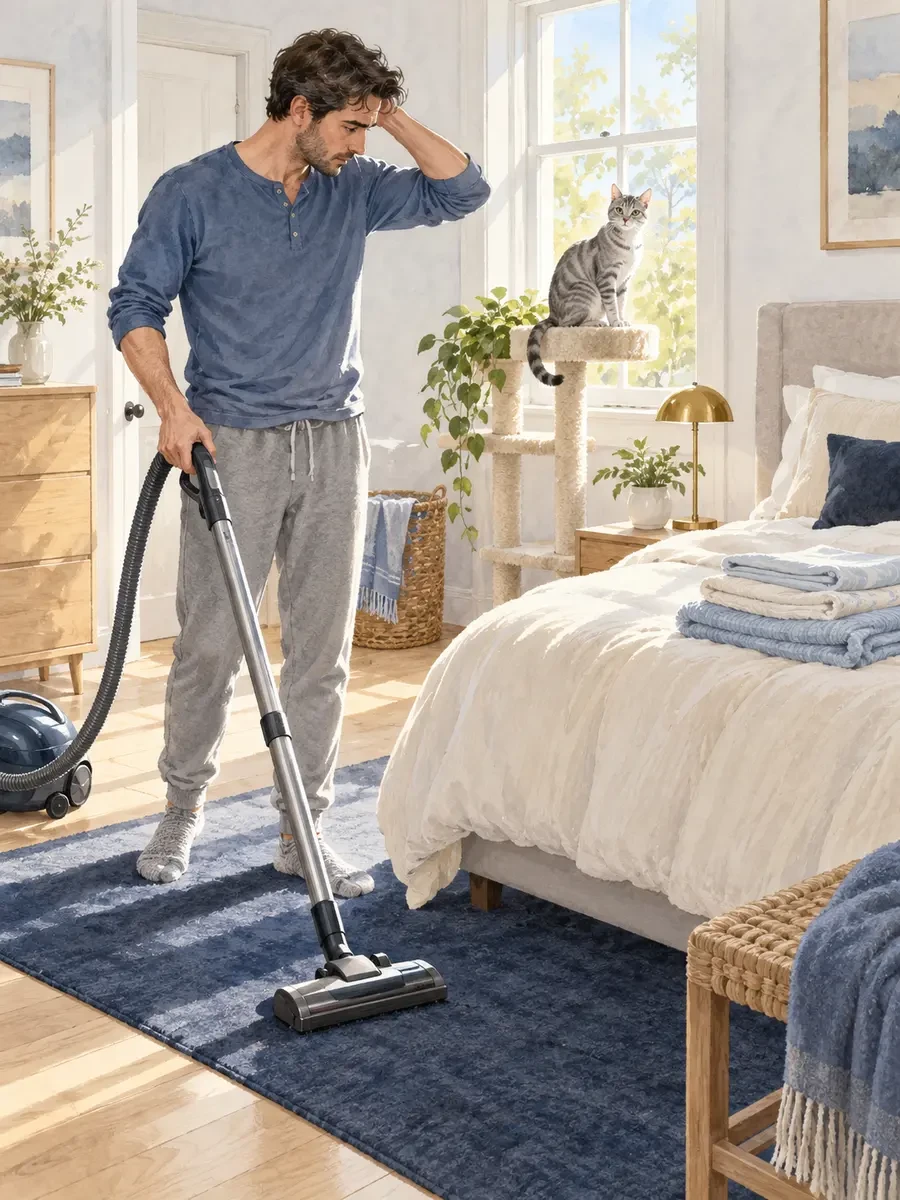
Change sheets, vacuum, wipe down the sofa, turn on the air purifier—even keep your cat out of the bedroom. But when your nose starts acting up again, it's easy to blame "not clean enough" or feel worse thinking, "Maybe I shouldn't have gotten a cat?"
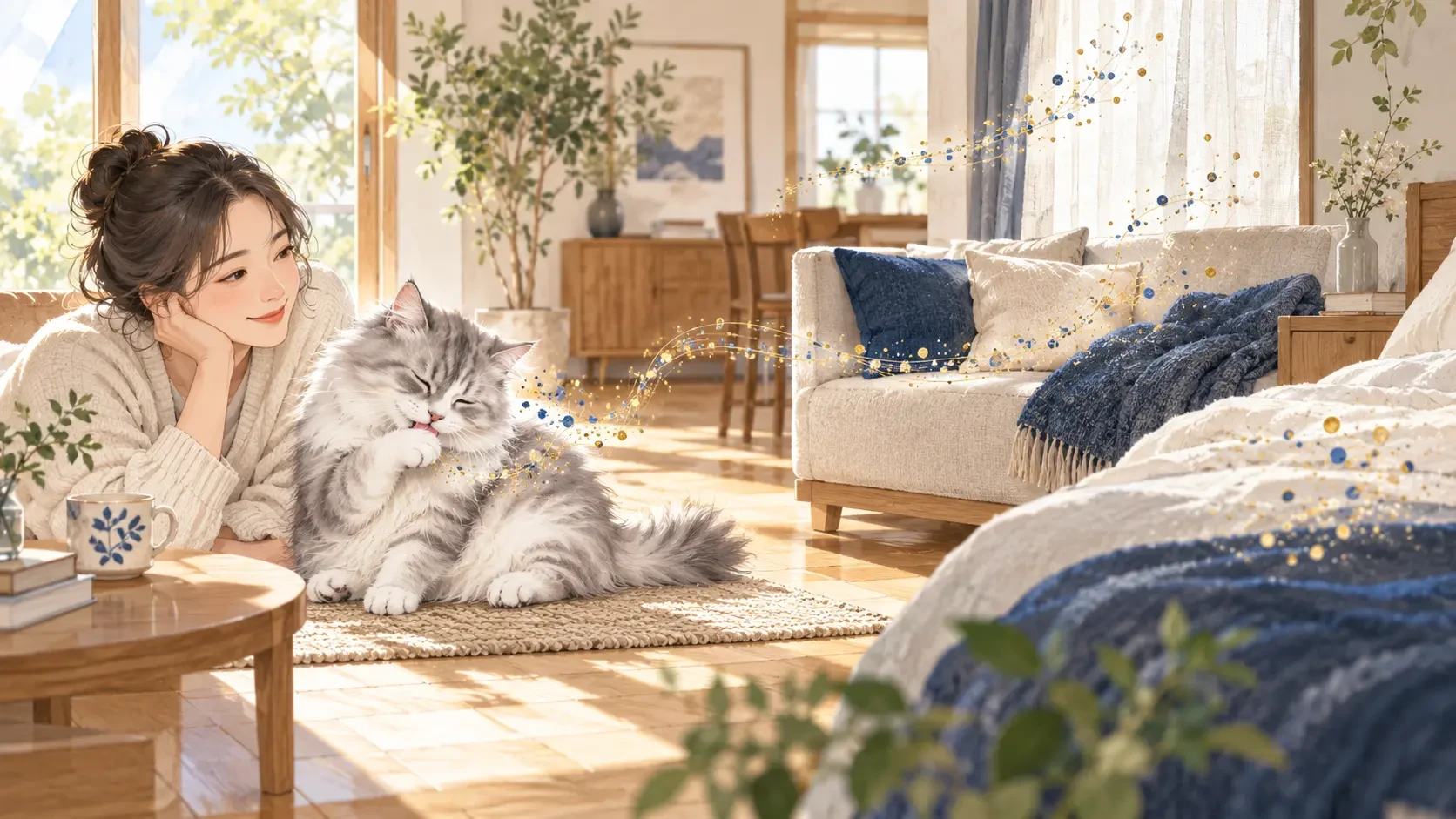
The real issue isn't a lack of effort—it's that cat allergens don't stay where you can see them. They travel from the cat via fur, dander, and particles into fabrics, furniture, and the air, then get carried back into living areas through contact and movement. You're dealing with a continuous cycle, not a one-time mess that a deep clean can erase.[2]
Therefore, "what to buy" is actually the last question. Before that, you need to clarify: where cats go most often, who interacts with them the most, which actions are already happening, and how much extra time the household is willing to commit. Once these four points are clear, your product transforms from a scattered collection of items into an actionable path.
People don't just buy pet products—they're buying solutions to four unmet needs.
I want to be close with my cat and not keep it outside.
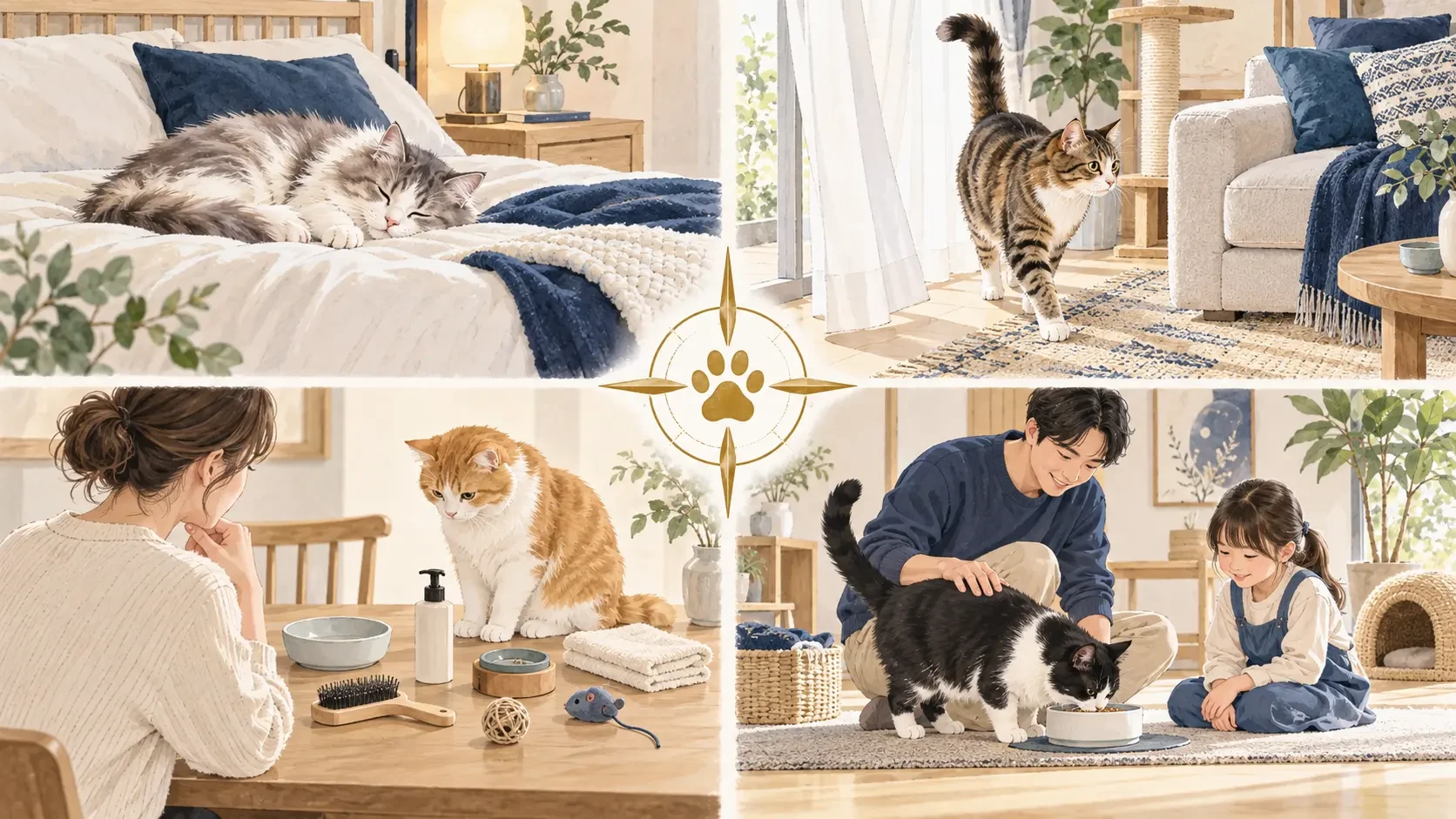
Bedrooms, sofas, and cuddles are where your bond is closest—and where fur and fabrics come into contact most often. The issue isn't that you spoil your cat too much; it's that high-contact areas need a gentler management approach.
- You may be experiencing:Cats often sleep at the foot of the bed, by the pillow, or on the sofa. Daily interactions include holding, cuddling, and brushing the cat. Family members are unwilling to enforce a long-term "no entry" rule.
- Common Misconceptions:Treating "complete isolation" as the only solution leads to giving up after a few days due to guilt or impracticality, causing management efforts to reset to zero.
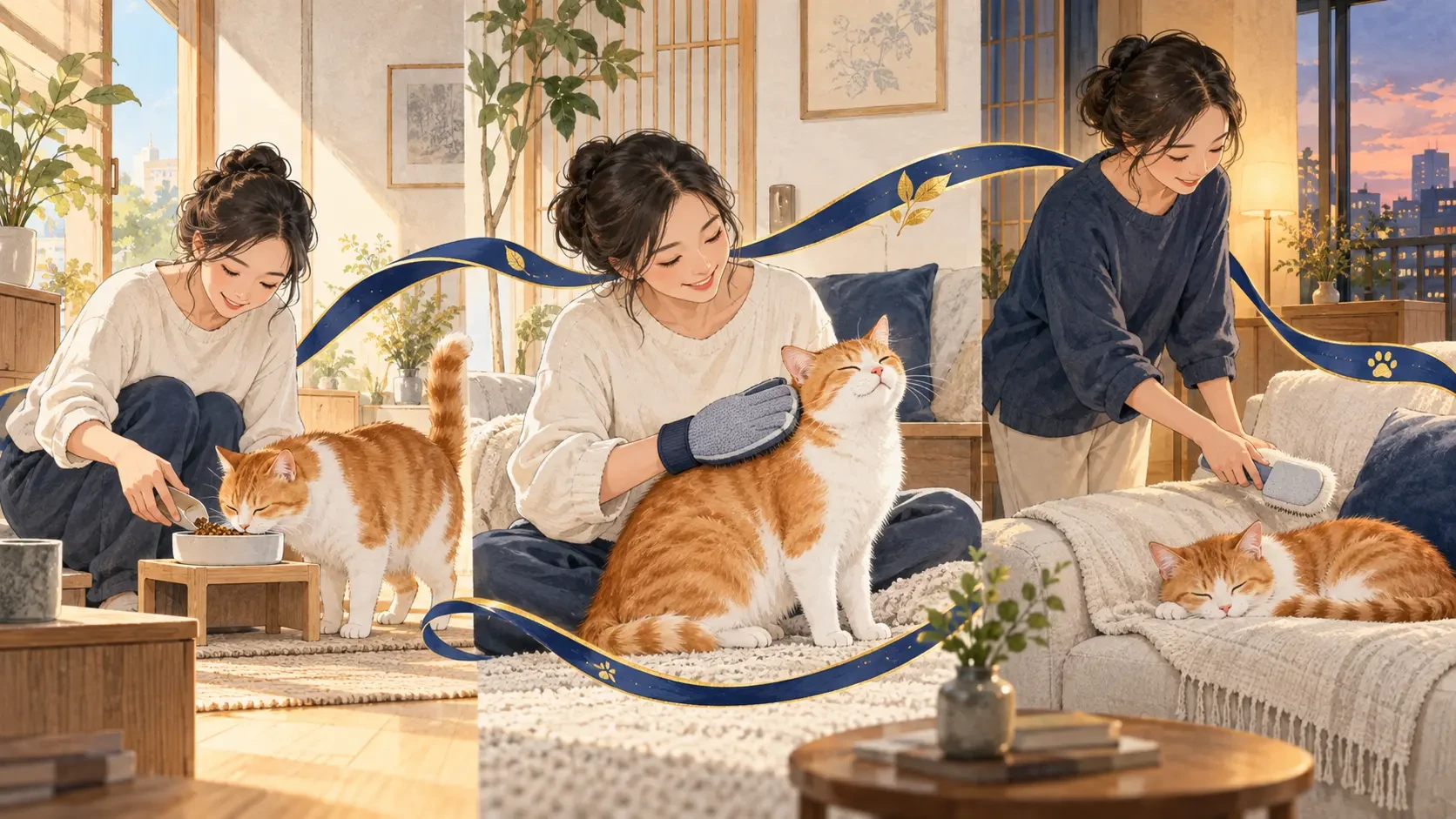
- What to do first:Add one source action to Daily Feeding, then bind a single Grooming session to the most frequent bonding moment.
- When to add a layer:Address environmental layers only after high-contact textiles like bedding and cushions remain a concern. No need to cover the entire home on day one.
I've been cleaning, but I'm not sure if it's actually working.
Visible cat hair is suctioned away, but Fel d 1 proteins can also enter the air, dust, and fabrics on smaller particles. Without exposure mapping, the more frequently you clean, the more exhausted you become.[5]
- You may be experiencing:Floor looks clean, but still feel uneasy after making the bed or sitting on the sofa; vacuum daily but unsure where to focus first.
- Common Misconceptions:Treat "hair not visible" as "path already cut off," ignoring continuous input from fur, soft furnishings, cat beds, and areas around the litter box.
- What to do first:Plot the five most frequented spots for your cat, then select the top two areas with the highest contact frequency as this week's focus.
- When to add a layer:Once high-touch areas are under stable management, gradually expand to air, low-frequency fabrics, and corners to avoid spreading efforts too thin.
I bought quite a few items, but I'm not sure of the order.
Dry food, mixing powders, wipes, shampoos, sprays, and litter are not interchangeable products. They serve distinct roles across the source–coat–home spectrum. Clarify each product's function first to determine what to use now and what can be postponed.
- You may be experiencing:Multiple products already stored in the cabinet; items are only retrieved when remembered. When switching products, you can only compare price, scent, or packaging—not task suitability.
- Common Misconceptions:Added multiple products simultaneously without tracking which node each corresponds to, making it impossible to determine which actions should be retained.
- What to do first:Label existing supplies as "Source," "Fur," and "Environment." Keep only one easy-to-start action per layer.
- When to add a layer:Add products only when a specific layer has uncovered nodes. Do not invest time or budget in "more products" for its own sake.
I need something sustainable, not just a one-week burst of enthusiasm.
A truly viable home solution must be frictionless: seamlessly integrating feeding, petting, litter cleaning, and laundry instead of adding a complex daily ritual. Sustainability isn't an add-on; it's the core of the solution.
- You may be experiencing:Heavy cleaning only on weekends; minimal effort on weekdays. Unclear division of household chores among family members. Tasks get interrupted when busy.
- Common Misconceptions:Prioritize intensity over consistency: complete all exercises in week one, then stop entirely in week two due to excessive time costs.
- What to do first:Start by locking in one daily anchor and one weekly anchor, then execute consistently for two weeks. Don't worry about completing other actions yet.
- When to add a layer:Add a new layer only when the existing action requires no reminder to complete; new actions must be tied to existing life events.
The issue isn't just "shedding"—it's the ongoing exposure pathway: source → coat → home.
Cat dander often acts as a carrier. When cats groom, proteins from their saliva transfer to their fur; subsequently, hair, skin flakes, and microscopic particles enter the home environment. Public studies show that airborne Fel d 1 can exist in particles of various sizes, and household dust may take months to significantly decrease even after the cat is removed.[2][3]
The requirements have changed:It's not about how much fur you remove today, but whether you can reduce ongoing input and manage high-contact points while maintaining closeness between people and cats.
Three stages of exposure paths
- Cat Source:Fel d 1 allergen proteins are produced by sources such as saliva and sebaceous glands.
- Hair and Dander:Protein adheres to the fur after grooming and transfers with hair and particles.
- Shared EnvironmentFabrics, air, and contact surfaces continuously accumulate and redistribute contaminants back into living areas through contact and movement, creating a cycle.
Four things a good solution should accomplish
- Continue bonding with the cat instead of isolating it:Integrate high-touch areas into the plan so bedrooms, sofas, and hugs are no longer zones you have to give up.
- Understand why the action is effective instead of cleaning indefinitely:Each action corresponds to a specific node and clearly defines whether it handles source, coat, or home.
- Reduces repeated input instead of just handling already shed hair:Set interception points at the source, fur transfer, and environmental deposition stages.
- Consistency over one-time deep cleaning:Actions should integrate with feeding, bonding, litter cleaning, and laundry, rather than introducing a separate ritual.
Products on the market are not ineffective; most only address a single segment of the distribution path.
When evaluating solutions, don't rely on a single metric alone. Assess whether it covers source, coat, or home, and check if uncovered nodes are still receiving continuous input. A single point being effective doesn't guarantee full path coverage. The key is understanding what each measure can do—and what it cannot cover.
Source-based diet and supplementation approach
- What you can do:Integrate interventions into daily feeding to act at the source.
- Why is it still incomplete?Public anti-Fel d 1 IgY research primarily targets Fel d 1, observing an average reduction in active Fel d 1 on fur starting from week 3. Commercially available similar supplements also often target Fel d 1. They do not directly address other nodes that have already entered the coat, bedding, and indoor environment.[4][6][8]
Environmental Spray
- What you can do:Process target surfaces or air scenarios within an existing home environment.
- Why is it still incomplete?It occurs at the back end of the transmission pathway; if the cat source and fur layer continuously release allergens, environmental interventions must be repeated. Commercial sprays also primarily target Fel d 1.[7]
Air Purifier
- What you can do:Filtration of airborne particles within a specific range complements ventilation and source control.
- Why is it still incomplete?It does not address all pathways, including source control for cats, direct fur contact, or allergens already deposited on fabrics. The EPA also positions filtration as a supplement to source control and ventilation.[9]
Bring home different categories
- What you can do:For feeding, cleaning, and grooming.
- Why is it still incomplete?Product documentation is often fragmented, lacking a unified node map, clear sequencing, or defined family roles. More products do not necessarily mean broader coverage; they may instead increase execution costs.
OKCLEAR's approach: mapping pain points, key milestones, and your product on a single canvas.
For families seeking closeness while balancing coverage, response speed, and sustainability, OKCLEAR offers a more complete, modular daily management path that starts from a single key node. It's not about adding another product—it's about ensuring every action knows its role in the layer it serves.
Difference from common single-sign-on solutions
- Problem Definition:Most common SSO solutions focus on visible cat hair, single proteins, or single rooms. OKCLEAR defines the problem using a Fel d 1–8 R&D map and a complete exposure pathway.
- Use cases:Common solutions typically focus on a single layer—source, coat, or home. OKCLEAR supports all three layers in combination.
- Product Relationship:Instead of each category being explained and used separately, the seven products now share a single path map with defined roles at each stage.
- Start with:Don't start by picking a product and then checking if it's useful. Instead, identify the biggest pain point first, then select the smallest actionable combination to address it.
- Speed Rating:Public studies report hair indicator changes starting from week 3. OKCLEAR SKUs show target indicator changes as early as Day 1 under specified test conditions. These are not head-to-head clinical comparisons.
Define more completely: From Fel d 1–8
Fel d 1 is important, but it doesn't represent the full scope of cat allergens. OKCLEAR treats Fel d 1–8 as a broader R&D and patent roadmap, using a multi-target approach to eliminate the blind spot of simplifying "cat allergies" to a single protein.[1]
More complete path: source–coat–home three-layer linkage
The seven products span key moments: feeding, grooming, periodic care, fabric and surface cleaning, and litter box maintenance. They aren't seven isolated silos—they're different tools along a single customer journey.
Faster feedback: Relevant SKU testing in as few as 1 days
Under OKCLEAR's defined test conditions, target allergen-related indicators can be observed in as few as 1 days; the public anti-Fel d 1 IgY dietary study reported hair indicator changes starting at week 3.[6]This is not a head-to-head clinical comparison, nor does it equate to improvement in human symptoms.
Start flexible: tackle the biggest pain point first, then layer on capabilities step by step.
Families don't need to buy all products at once. Start with a single daily anchor or high-touch scenario, and only add the next layer when gaps are clearly identified—lowering time and budget barriers.
1-Minute Family Path Self-Test
Determine whether you need a product or a path connecting multiple nodes. This is not for medical diagnosis or allergy risk scoring; it's for planning household actions. Read across four dimensions and tally one point for each match.
How close are you to your cat?
- Cats enter the bedroom daily or rest on sofas and bedding.
- Family members have a daily routine of hugging, nuzzling, brushing, or letting the cat sit on their laps.
Where do cats most often stay?
- Ideal for homes with multiple carpets, fabric sofas, curtains, cat beds, or plush textiles.
- Cleaning frequency is high, but primarily determined by visible cat hair.
Are the current actions divided by role?
- More than two products exist, but it's unclear which one handles source, coat, or home.
- There is no fixed division of labor among family members regarding feeding, grooming, or handling textiles.
Can a family sustain this long-term?
- Previously attempted strict isolation or intensive cleaning, but stopped within two weeks.
- Want to stay close to your cat while keeping management actions sustainable.
How do I use the results?
- Select 0–2 items · First, create an anchor point:Pick the easiest habit to stick with—either the daily feeding routine or a fixed grooming session—and do it consistently for two weeks.
- Select 3–5 items · Connect two levels:Start from source + coat or coat + home; manage only the two highest-touchpoint positions to avoid solution overload.
- Select 6–8 items · Sort first, then combine:First, create a high-touch map and assign household roles. Then establish three rhythms: daily, post-contact, and weekly. Do not enable all products at once.
An easier daily routine to stick with
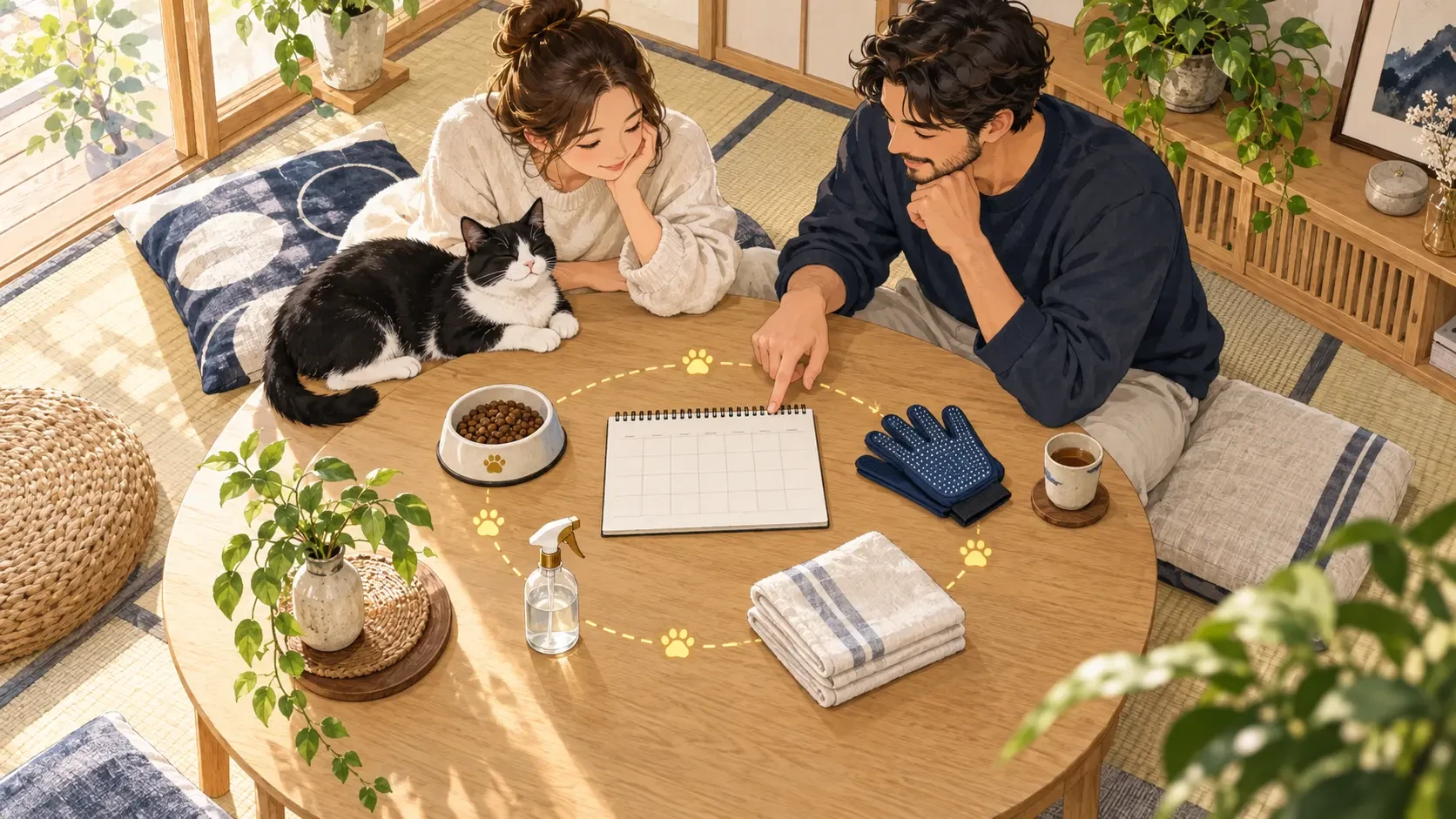
Don't turn your home into a lab; embed management actions into the routines that already happen. Start with one daily anchor and one weekly anchor—only actions that naturally repeat can build long-term value.
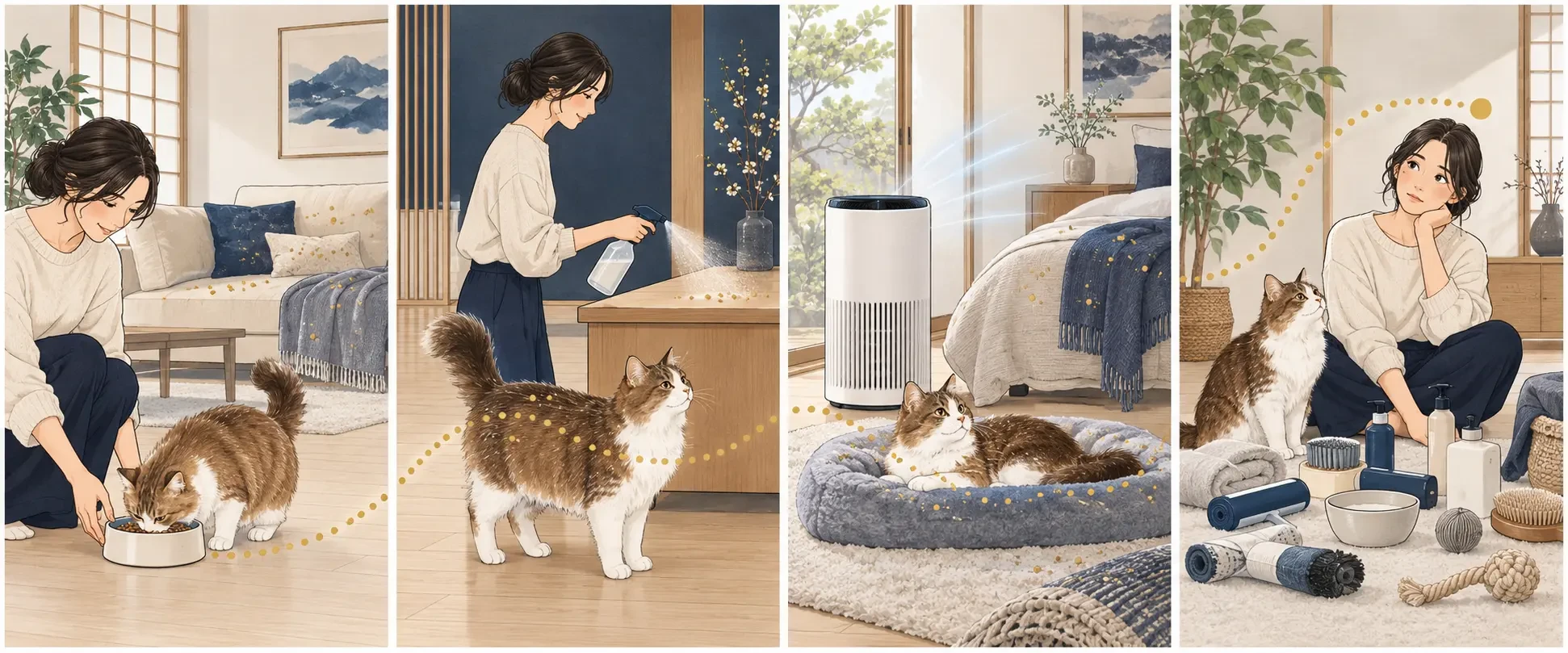
- Morning · During feeding, prioritize the source layer first:Complete, full-life-cycle baked cat food or hairball-clearing powder. Integrate source management into habits your cat already accepts daily.
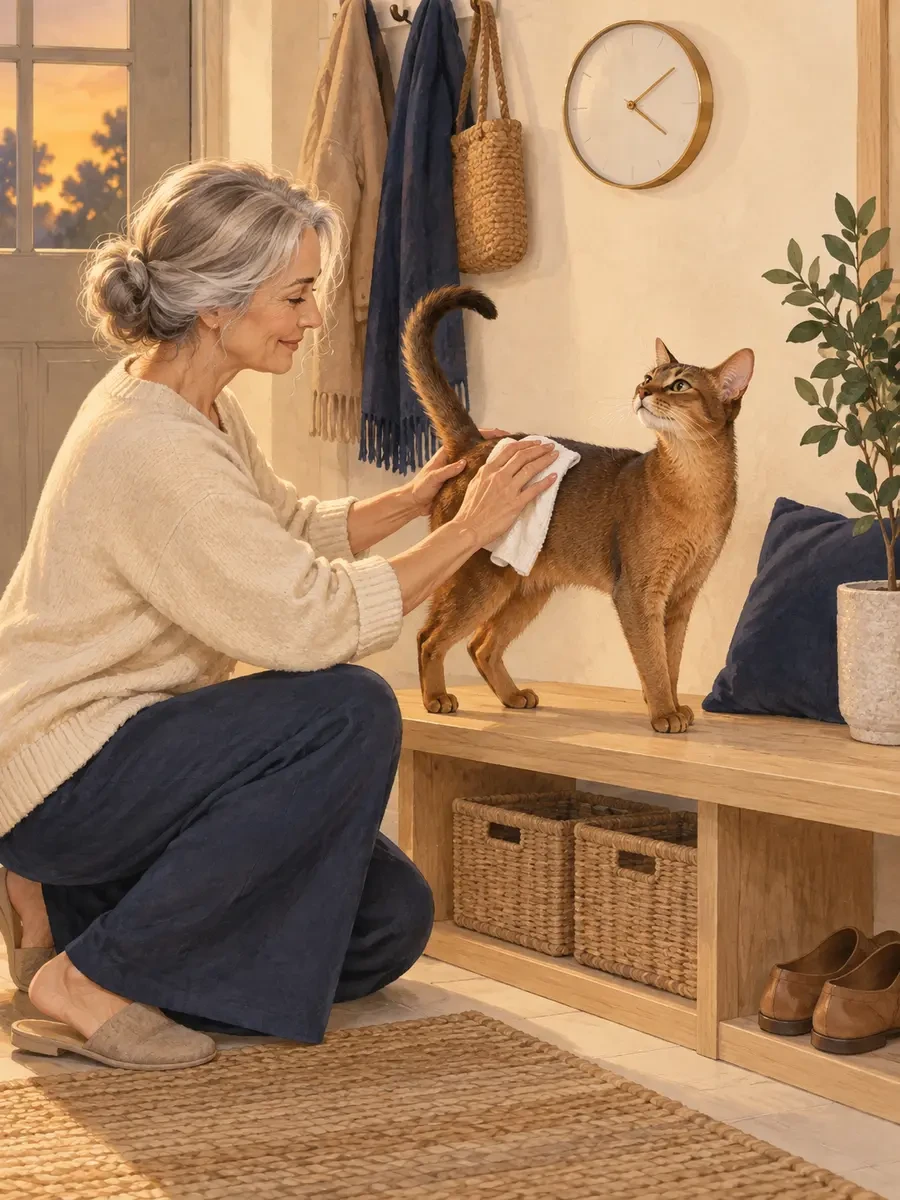
- After petting, gently wipe high-contact fur:Wash-free cleaning gloves are perfect for cuddling, grooming, or quick de-shedding after coming home outdoors—no need to turn every interaction into a bath.
- Daily Cleanup · Sanitize Surfaces Your Cat FrequentApply the environmental spray to suitable fabrics or surfaces as directed, including areas around the litter box—not just the living room floor.
- Periodic Care: Complete Your Coat Cleanse with ShampooSchedule grooming based on the cat's tolerance and product instructions. Separate periodic actions from high-frequency wiping, assigning each its appropriate role.
The logic isn't "do more, do better"; it's that every action knows which layer it's solving.
These seven products are not seven silos, but tools across three tiers.
OKCLEAR uses Fel d 1–8 as a broader R&D roadmap and covers different exposure points with technologies and product formats such as IgY. Fel d 1–8 represent eight distinct feline allergen components, not eight versions of a single ingredient. Final product conclusions are based on the formulation, testing, and documentation specific to each SKU.[1]
- Source (Daily):Complete, All-Stage Baked Cat Food & Hairball Relief Powder — Integrate care into feeding habits without disrupting your cat's daily routine.
- Coat (Frequent Wiping + Periodic Washing):Wash-free cleaning gloves and anti-cat-allergen shampoo for grooming pets that are frequently held, petted, and sleep on the couch.
- Environment (by contact scenario):Anti-cat-allergen spray and cassava cat litter—covering overlooked areas such as fabrics, hard surfaces, and zones around the litter box.
Choose your starting point based on your situation
- If your top priority is to keep your cat's routine unchanged:Prioritize actions that can be integrated into feeding or petting routines to lower the execution barrier.
- If your top concerns are sofas, bedding, and high-contact areas:Connect the coat to the environment. Don't let care stop at surface cleaning.
- If you're most worried about not sticking with it:Start with one daily and one weekly anchor. Once stable, expand—don't schedule everything on day one.
OKCLEAR organizes product roles as source–coat–home and monitors target allergen indicators under established testing conditions for each product. Changes in target allergen indicators do not equate to improvement in human symptoms and do not constitute a diagnosis or treatment promise.
What truly needs to be solved goes beyond allergens.
It's about ending the back-and-forth over whether to keep a cat away from your home. Responsible allergen management shouldn't turn cats into the problem or burden owners with guilt. Instead, it should translate complex science into clear daily actions: where to start today, what to cover next, which expectations are realistic, and which boundaries must be clearly defined.
This is what OKCLEAR aims to do: not promise a one-size-fits-all shortcut, but establish a simple, practical, and sustainable daily management routine for the source, fur, and environment that any household can understand, implement, and stick with.
5 questions to ask before you buy
Clear boundaries are essential for respecting people, cats, and building long-term trust.
Is OKCLEAR a medication?
No. OKCLEAR is a brand dedicated to daily management of cat allergens in pet and home environments. It is not intended for diagnosis, treatment, or as a substitute for human medication or professional medical advice.
Do all products need to be purchased at once?
No. source–coat–home is a management map, not a mandatory shopping list. Start with the easiest anchors that align with your daily habits, then gradually add items based on your cat's activity range and home interaction scenarios.
"Fastest Day 1" indicates symptom relief within a single day?
No. This refers only to the fastest 1 days to observe changes in target allergen markers under OKCLEAR's established product testing conditions; marker changes do not equate to symptom improvement in humans. Specific conclusions are subject to the corresponding SKU documentation.
Do I need to clean and ventilate after using the product?
Essential. The product suite is designed to help manage different nodes, not to make daily cleaning, air management, or doctor recommendations obsolete. Layered measures each have their boundaries and better align with real-world household exposure pathways.
What should I do if a family member shows clear allergy symptoms?
Consult a doctor or allergist first for proper evaluation. Home allergen management can be part of your living environment but cannot replace diagnosis and treatment.
Read more
Want to see the evidence? View the full audit for Fel d 1–8, airborne transmission, IgY, environmental interventions, human evidence, and product validation boundaries.
Read the OKCLEAR Cat Allergen Research White Paper →
Cite this article
- WHO/IUIS Allergen Nomenclature — Felis domesticus allergens: Fel d 1–8
- Luczynska et al. Airborne concentrations and particle size distribution of Fel d 1. Am Rev Respir Dis. 1990.
- Wood et al. Effect of cat removal on household dust allergen levels. J Allergy Clin Immunol. 1989.
- Satyaraj et al. Reduction of active Fel d 1 from cats using an anti-Fel d 1 egg IgY antibody. Immun Inflamm Dis. 2019.
- Portnoy et al. Environmental assessment and exposure control: a practice parameter—furry animals. 2012.
- Purina Institute — Anti-Fel d 1 IgY: Active Fel d 1 reduction in saliva and hair starting Week 3.
- PacaGen — Cat Allergen Neutralizing Spray: an environmental product that targets airborne Fel d 1.
- PacaGen — Cat Allergen Reduction Supplement: A Source-Oriented Product Targeting Fel d 1.
- U.S. EPA — Air cleaners and filters supplement source control and ventilation but do not remove all indoor pollutants.
Start with the easiest habit to stick to.
Explore the OKCLEAR product lineup or contact our team to discuss products and partnerships.


IMPORTANT
This content is for general health and scientific education only and does not constitute medical advice, diagnosis, or treatment. If you have concerns about allergies or asthma, please consult a qualified healthcare professional.
OKCLEAR
Need product documentation or proof?
This will open your default email client. We will prepare the relevant materials based on the project scope.